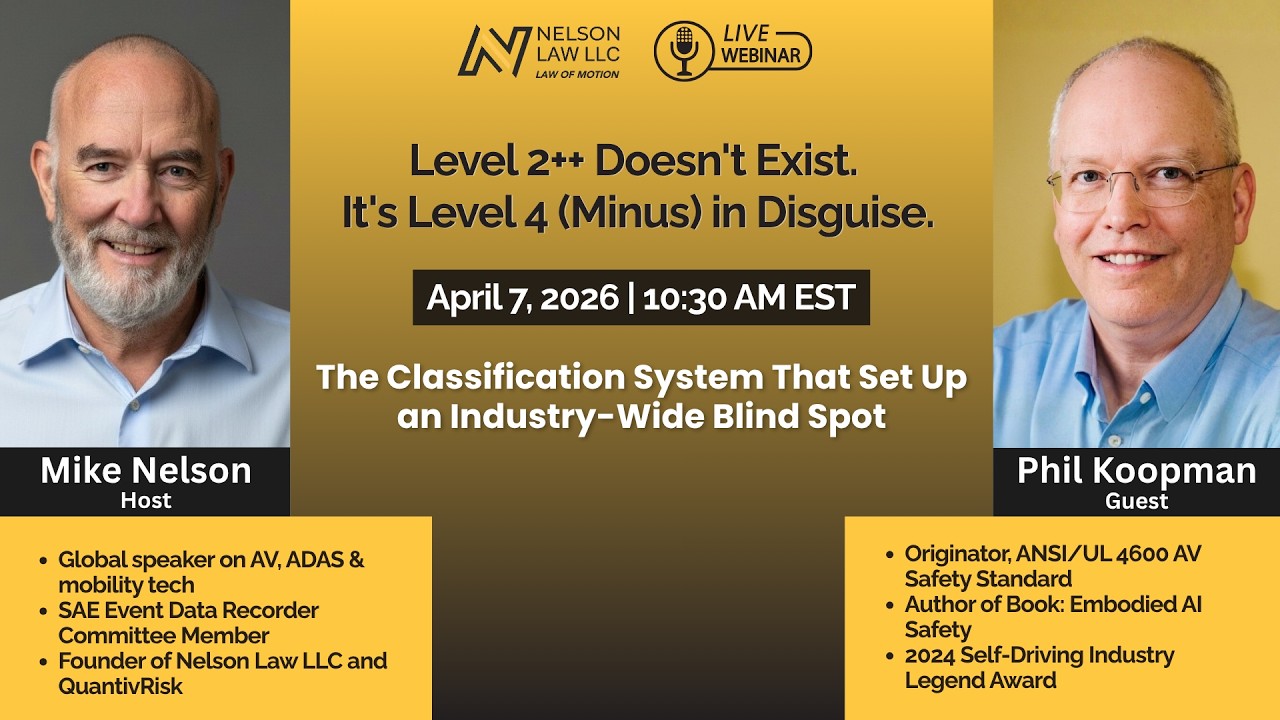
Watch as Mike “Mobility Nerd” Nelson and Dr. Phil Koopman unpack why today’s advanced vehicle technologies have already outgrown the SAE J3016 framework, and how many are mistakenly using an engineering taxonomy as if it were a legal shield.
As automation improves, something counterintuitive happens. Drivers don’t become safer, they become more disengaged. Increased reliability leads to boredom, distraction, and ultimately complacency behind the wheel.
This creates a dangerous paradox:
The better the automation performs, the less attentive the driver becomes
The driver’s perception-reaction time (PRT) slows down significantly
When the system inevitably fails, the driver is suddenly expected to react instantly
In that critical moment, the human is forced to jump from passive observer to emergency operator, often without enough time or situational awareness to respond effectively.
And yet, despite this growing mismatch:
The driver is still held responsible for any failure to intervene
Companies continue to rely on labels like “Level 2” to frame expectations
Many assume these labels reduce liability, when they actually do not
The key takeaway is simple but powerful:
Calling something “Level 2” doesn’t change the physics, the human limitations, or the legal responsibility.
If anything, it can create a false sense of security that makes the system more dangerous, not less.